
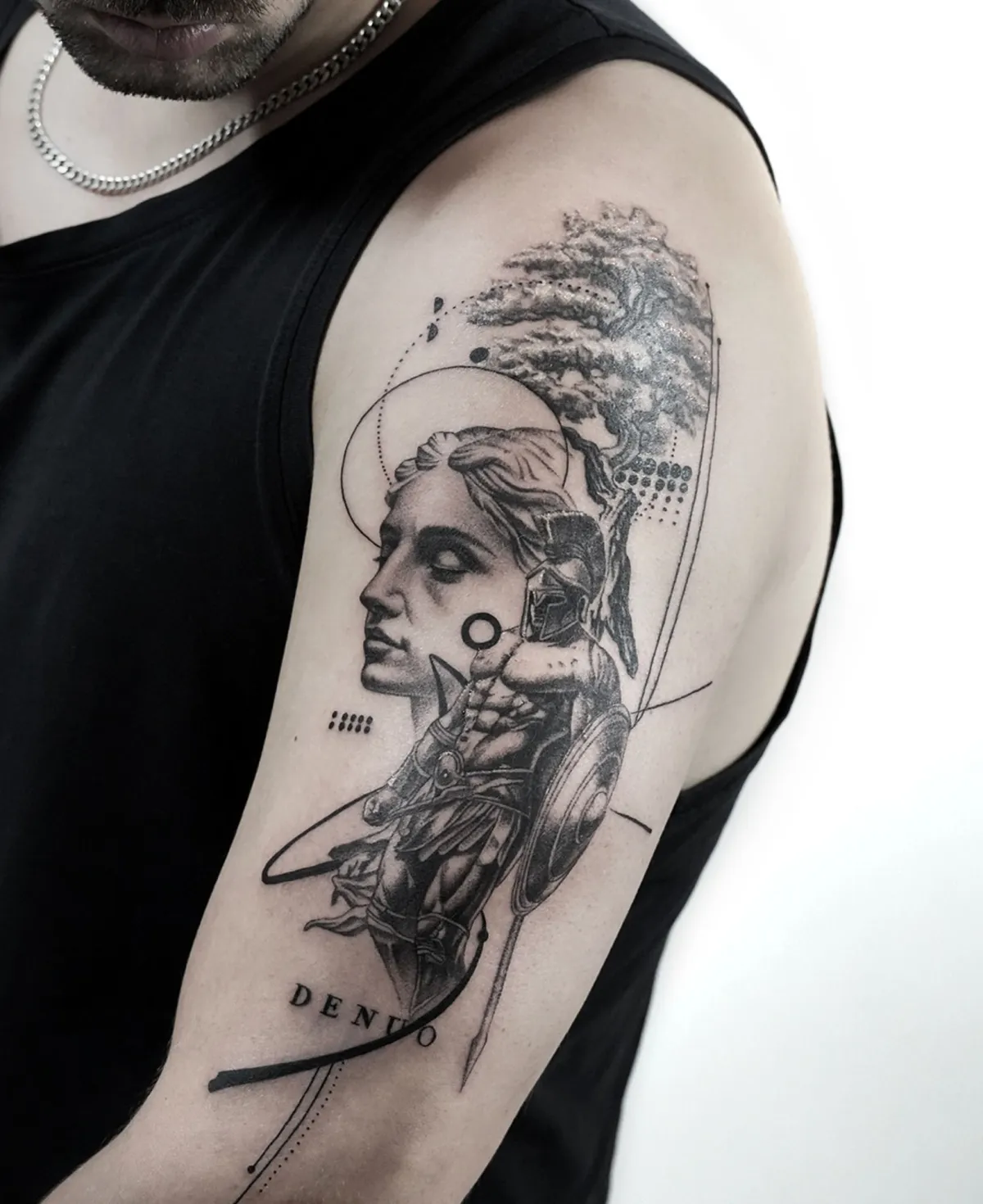
Nobody Gets a Tattoo Planning to Cover It Up
That's the thing people don't always understand about cover-ups. When someone walks into my studio asking to cover an old piece, they're not just asking for a new tattoo. They're asking me to help them close a chapter. Every cover-up carries two stories -- the one someone wants to leave behind and the one they want to carry forward.
I've done a lot of cover-ups over the years, working between Helsinki, Amsterdam, and Berlin. Some are technically straightforward. Some are among the most challenging pieces I've ever done. But every single one has taught me something about change, about growth, and about the strange permanence of ink on skin.
Let me tell you about a few of them.
The Name That Needed to Go
I'll be honest: name cover-ups are probably the most common request I get. And I never judge. Not once. Not ever.
A client came to me -- let's call him Mikko -- with his ex-partner's name in bold black script across his inner bicep. The letters were thick, about two centimeters tall, in a heavy Gothic font. He'd had it done five years earlier when the relationship felt like forever. Now it felt like a weight he carried everywhere.
The challenge with name cover-ups, especially in bold black, is that you're working against a lot of existing ink. You can't just put something light and delicate over heavy black lettering and expect it to hold. The old ink will ghost through. So you need a design that's dense enough to absorb the existing lines while still looking intentional and beautiful on its own.
For Mikko, we designed a dark botanical piece -- a cluster of blackwork leaves and berries that wrapped around the arm. The heavy blacks of the old lettering actually worked in our favor, becoming the deep shadows within the foliage. When it healed, you couldn't find a single trace of the name unless you knew exactly where to look.
Mikko told me afterward that he'd been wearing long sleeves for two years, even in summer, because he didn't want people to see the name and ask about it. The week after the cover-up healed, he wore a tank top for the first time in ages.
That's what a cover-up can do. It's not just cosmetic. It's liberation.
The Scratchy First Tattoo
Not all cover-ups are about emotional baggage. Some are simply about quality.
A young woman -- I'll call her Laura -- came in with a small tattoo on her ankle that she'd gotten at sixteen from a friend who was "practicing." It was supposed to be a butterfly. It looked more like a moth that had been through a windshield. The lines were wobbly, the proportions were off, and the ink had spread in some areas, creating a blurry mess.
Laura didn't have any trauma associated with the tattoo. She actually laughed about it. But she'd wanted a beautiful butterfly on her ankle since she was a teenager, and she felt like this botched version was mocking that desire every time she looked at it.
We designed a proper fineline butterfly that incorporated the existing ink's placement. I used the spread areas as natural shading zones within the new design, turning the blurriness into soft grey tones in the butterfly's wings. The clean new lines gave structure to what had been chaos.
This kind of cover-up is pure technical problem-solving, and I love it. You're essentially reverse-engineering a design that turns existing flaws into features. It's like a puzzle where the pieces are already glued down and you have to build something beautiful around them.
The Tattoo from Another Life
This one stays with me.
A client came in from Berlin during one of my guest spots there. I'll call him Jens. He had extensive tattoo work on both arms from his twenties -- a period in his life he described as "lost years." The tattoos were associated with a subculture and lifestyle he'd completely left behind. They were well-executed technically, but every time he looked at them, he saw a person he no longer was.
Jens didn't want to erase his past entirely. He was clear about that. He said, "I don't want to pretend those years didn't happen. But I want to transform them into something that represents who I am now."
This is the kind of cover-up project that requires deep collaboration. We spent three sessions just talking and sketching before any ink was involved. We developed a design language that wove through and over his existing tattoos -- flowing organic forms, waves, botanical elements -- that gradually transformed the old imagery into something new. Some of the original work was fully covered. Some of it was incorporated, its meaning shifted by the new context around it.
The project took four sessions over six months. When it was finished, Jens stood in front of the mirror for a long time. He said something I think about often: "It finally looks like me."
"I don't want to pretend those years didn't happen. But I want to transform them into something that represents who I am now."
That's the philosophy I try to bring to every cover-up. We're not erasing history. We're transforming it.
The Technical Side: What Makes a Good Cover-Up
Let me get practical for a moment, because I know a lot of people reading this might be considering a cover-up and wondering what's possible.
Darkness covers darkness. The most important rule. You generally can't cover a dark tattoo with a lighter one. The old ink will show through. This doesn't mean every cover-up needs to be a big black blob -- but the new design needs strategic areas of density that align with the heaviest parts of the old tattoo.
Size matters. A cover-up almost always needs to be larger than the original. This gives me room to extend the new design beyond the borders of the old one, so the old edges don't peek out. If your old tattoo is the size of a coin, the cover-up might be the size of your palm. This isn't a hard rule, but it's a realistic expectation.
Color can help. Black and grey cover-ups work well, but sometimes introducing color gives us more tools. Rich, saturated colors like deep reds, blues, and purples can effectively mask old black ink when layered correctly. Every situation is different.
Laser removal before a cover-up. Sometimes I'll recommend one or two laser sessions before we start the cover-up. This lightens the old ink enough that we have more design freedom. It doesn't need to be fully removed -- even a partial fade can make a huge difference in what's possible. I always discuss this option honestly with clients.
Not everything can be covered perfectly. I believe in honesty. If someone comes to me with a large, dark, heavily saturated tattoo and wants it covered with a tiny delicate fineline piece, I'll tell them that's not realistic. I'd rather give you an honest assessment and a great result than overpromise and underdeliver.
The Emotional Weight of This Work
Cover-ups sit at a unique intersection of technical skill and emotional sensitivity. When someone shows me a tattoo they want covered, they're often showing me something they feel ashamed of, embarrassed by, or pained by. That's vulnerable. I respect that vulnerability every single time.
I never make fun of old tattoos. I never say "wow, who did this to you?" even if the work is objectively bad. Someone sat in a chair and trusted an artist with their skin, and it didn't work out. That's not funny. That's just life. People change, circumstances change, and sometimes the ink on your body doesn't change with you.
My job is to meet you where you are now and help you move forward.
Thinking About a Cover-Up?
If you've been living with a tattoo that no longer feels like you, here's my honest advice:
Don't rush. A cover-up is a bigger commitment than the original tattoo because we're working within constraints. Take time to think about what you actually want, not just what you want to get rid of.
Come in for a consultation. Every cover-up is unique. I need to see the old tattoo in person, feel the texture of the skin, assess the ink density and color. Photos help for initial conversations, but the real planning happens face to face.
Be open to the process. The best cover-ups happen when clients trust me to design something that works with the constraints rather than fighting against them. If you come in demanding an exact design that doesn't account for the old tattoo, we're going to struggle. But if you give me a direction and some creative freedom, I can usually create something that exceeds your expectations.
Know that it's worth it. Every single client I've done a cover-up for has told me the same thing: they wish they'd done it sooner. The relief of looking at your body and seeing something you love instead of something you've been hiding -- that's powerful. That's worth every minute in the chair.
If you're carrying a tattoo that feels like it belongs to a different version of you, reach out. Let's talk about what's possible. Let's give that old ink a new life.