
It Never Starts Pretty
There's a romantic image of the tattoo artist sitting down with a blank sheet of paper and producing a perfect design in one fluid session. I hate to ruin the illusion, but that's not how it works. At least not for me.
My process starts ugly. Genuinely ugly. The first sketches I make after a client consultation are rough, messy, and sometimes barely legible. They're not meant to be beautiful -- they're meant to be thinking. Each rough thumbnail is me working through an idea, testing a composition, asking myself whether an approach has legs before I invest hours refining it.
I might do six or seven of these tiny sketches for a single piece. Most of them get crossed out. Some get circled. One or two get pulled forward into the next stage. That's the process working exactly as it should.
Rough Thumbnails: Thinking With a Pencil
The thumbnail stage is where I make the big decisions. Not the details -- those come later. At this point, I'm thinking about overall shape, flow, and composition.
Where is the visual weight? Does the design have a clear focal point? How does the eye move through it? Is there a sense of balance, or deliberate tension? These are the questions that matter at this scale, and they're easier to answer when you're working small and fast.
I sketch on cheap paper with a soft pencil. Nothing precious. The lack of preciousness is the point -- if I'm working on expensive paper with fine pens, I get careful. Careful is the enemy of exploration. At this stage, I need to be loose, make mistakes, and follow ideas without worrying about wasting materials.
One thing that surprises clients when I show them this stage: I'm already thinking about the body. Even in a two-inch thumbnail, I'm considering the curve of the arm, the taper of the forearm, the way the ribcage expands and contracts with breathing. A design that looks perfect on flat paper can fall apart completely when wrapped around a living, three-dimensional surface. So the body informs the composition from the very beginning.
Refining: Where the Design Gets Real
Once I've selected a thumbnail direction, I move into refinement. This is where the real drawing happens. I'll work up the sketch to actual size, adding detail, cleaning up proportions, and making deliberate choices about every element.
This stage is slower and more intentional. I'm thinking about line weight -- which lines should be thick and grounding, which should be thin and delicate. I'm considering the hierarchy of elements: what should the viewer see first, second, third? I'm balancing positive and negative space, making sure the design has room to breathe without feeling empty.
For my fineline work, this stage is especially critical. Fineline tattooing lives and dies on precision. Every line has to be purposeful because there's no thick shading to hide behind. If a line is slightly off in a bold traditional piece, the overall impact carries it. In fineline, every millimeter matters.
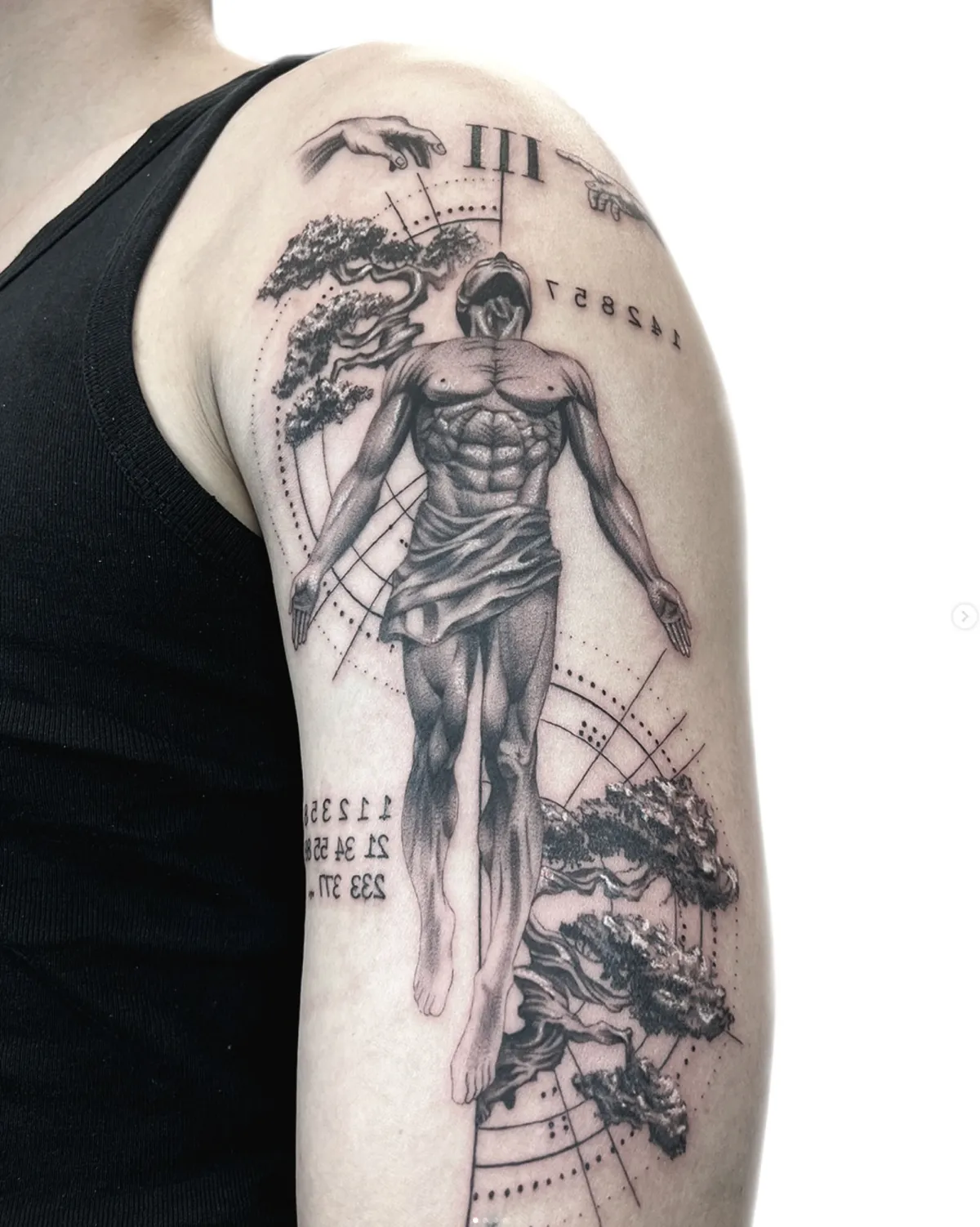
For black and grey realism, the refinement stage is where I work out the tonal range. I need to map out where the deepest blacks will live, where the mid-tones transition, and where I'll leave skin showing through as highlights. This tonal planning on paper directly translates to how I'll build up the tattoo in layers during the actual session.
A tattoo that looks effortless on skin is one that was meticulously planned on paper. The ease you see is earned through hours of invisible work.
Designing for Skin, Not Paper
This is something that took me years to fully understand, and it's one of the most important lessons in tattooing: skin is not paper. What works on a flat, white sheet does not automatically work on a curved, textured, living surface that moves and ages.
There are several key differences that I have to account for during the design process.
Contrast. On paper, you can achieve incredibly subtle gradations between tones. On skin, those subtle differences often disappear or merge together over time. I've learned to push my contrast further than I think I need to. The darks need to be darker, the transitions need to be more defined, and the highlights need more room. A design that looks slightly too contrasty on paper will often look perfect on skin.
Detail density. Paper holds detail at any scale. Skin doesn't. The finer the detail, the more it will soften and spread over the years as the ink settles into the dermis. I design with this aging in mind. If I'm putting tiny details in a piece, I make sure there's enough space between elements that they'll still read clearly in five or ten years, not just on the day they're done.
Body curvature. A design sits on a flat plane on paper. On the body, it wraps, stretches, and compresses depending on the location. An inner forearm has a gentle curve. A shoulder cap is a sphere. The ribs are a cylinder that moves with every breath. I have to anticipate how the flat design will distort when mapped onto these surfaces, and sometimes I'll deliberately skew the proportions on paper so that they look correct on the body.
Skin tone. Different skin tones interact with ink differently. The same design might need adjustments in contrast, saturation, and detail density depending on the client's complexion. This isn't something I can fully solve on paper -- it requires experience and real-time judgment -- but I keep it in mind during the design phase.
The Stencil: Where Design Meets Body
The stencil stage is one of my favorite moments in the whole process, because it's the first time the design leaves paper and meets skin. I transfer the design onto the client's body using a thermal stencil, and suddenly everything changes.
A design that looked perfectly balanced on my desk might feel too high or too low on the arm. A composition that read beautifully on flat paper might need to be rotated fifteen degrees to align with the muscle. An element that seemed proportionally correct might look too large or too small relative to the body part.
This is why I never rush the stencil placement. We'll often apply it, look at it together, take photos, discuss adjustments, remove it, reposition, and apply again. I've done three or four stencil placements on a single session before landing on the right one. Some clients feel bad about this, like they're being demanding. But I tell them: this is exactly what this step is for. A well-placed stencil is the foundation of a great tattoo.
I also make adjustments to the design itself during this stage. I might simplify an area that's falling into a tricky spot. I might extend a line to follow the body's natural contour more gracefully. The stencil isn't a rigid blueprint -- it's a guide that remains responsive to the reality of the body.
Live Adjustments: The Tattoo as a Living Process
Here's what a lot of people don't realize: the design keeps evolving even during the tattooing itself.
I work freehand to some degree on almost every piece. Not the whole thing -- the stencil provides the structure -- but within that structure, I'm constantly making small decisions in real time. The skin might take ink differently in one area than another. A shadow might need to be deeper than planned to create the right contrast. A line might need to curve slightly more to follow the grain of the skin.
This is especially true for black and grey realism, where so much of the work is about building depth through layered shading. I'll plan the tonal map on paper, but the actual execution involves reading the skin moment by moment. How is the ink sitting? Does this area need another pass? Is the gradient smooth enough? These micro-decisions add up to the difference between a tattoo that looks flat and one that has genuine depth and dimension.
For fineline work, the live adjustments are subtler but equally important. The pressure, speed, and angle of the needle all affect the quality of the line. A line that needs to be crisp and sharp requires different handling than one that should feel soft and organic. I'm adjusting these variables continuously throughout the session.
The tattoo machine is not a printer. It's an instrument, and like any instrument, how you play it determines what the audience hears.
Why the Final Piece Always Evolves
If you compared my initial thumbnail sketch to the finished tattoo, you'd see the same core idea -- the same story, the same emotion -- but the execution would be different in a hundred small ways. Every stage of the process adds something. The refinement adds precision. The body placement adds context. The live tattooing adds soul.
I think that evolution is beautiful. It means the piece is alive. It responded to the reality of its medium and its surface. It adapted, like any good art does.
Some clients ask me after their session, "Did you change anything from the design?" Usually the answer is yes, but the changes were so organic and intuitive that they served the piece without the client ever noticing. That's the goal: a finished tattoo that feels inevitable, as if it couldn't exist any other way on any other body.
The Craft Behind the Art
I share all of this because I want people to understand the depth of what goes into a custom tattoo. From the outside, it might look like you show up, lie down, and the artist just does their thing. But behind every finished piece are hours of sketching, refining, problem-solving, and adapting.
Whether I'm working in my Helsinki studio or during a guest spot in Amsterdam or Berlin, the process is the same. It starts with a story, becomes a sketch, transforms through refinement and body placement, and finally lives on skin as something that belongs only to you.
That journey from pencil to needle is what I love most about this work. Every piece teaches me something. Every body presents a new challenge. And every finished tattoo carries the weight of every decision that brought it to life.