
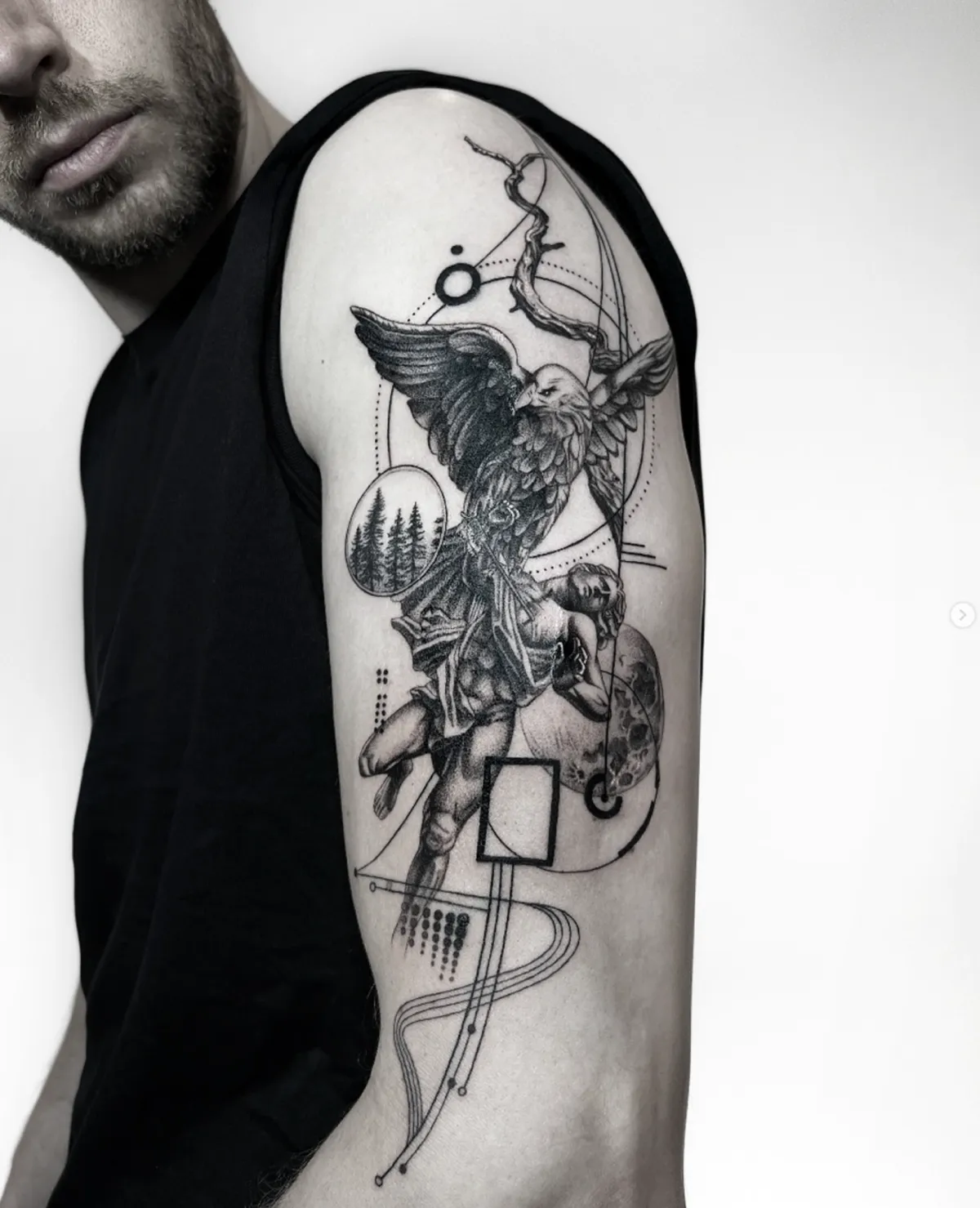
It Always Starts With a Conversation
When someone sits down across from me for a consultation -- whether that's at my studio in Helsinki, or during one of my guest spots in Amsterdam or Berlin -- I never start by drawing. I start by listening. I want to know who you are before I pick up a pencil.
A lot of people come in nervous. They think they need to have a perfect idea figured out before they book. They apologize for being vague. They say things like, "I'm not really an artsy person, I just know I want something meaningful." And honestly? That's the best starting point I could ask for.
I don't need you to be an artist. That's my job. What I need is your story.
Why I Don't Do Flash-as-Personal
I have nothing against flash tattoos. They serve a purpose. Walk-in flash days are fun, and there are beautiful flash designs out there that stand on their own. But when someone comes to me wanting a piece that represents something deep -- a memory, a person, a chapter of their life -- I won't just pull a design off the wall and call it done.
Here's why: a flash piece belongs to the artist. A custom piece belongs to you. There's a difference in how it sits on your skin when you know that no one else in the world has it. When every line was drawn with your specific story in mind. That feeling of ownership matters.
The most powerful tattoos aren't the most technically complex ones. They're the ones where the wearer looks down and feels something.
So when we work together, we're building something from scratch. Even if you bring me a reference image you love, we're going to break it apart and rebuild it around you.
From "Something About My Grandmother" to a Finished Design
Let me walk you through a real example -- details changed slightly to respect the client's privacy, but this captures how the process works.
A woman came to me in Helsinki and said she wanted a tattoo for her grandmother who had recently passed. She didn't have a specific image in mind. Just that feeling of wanting to carry her grandmother with her. She told me, "I don't know, maybe flowers? She liked flowers."
Now, I could have drawn a nice bouquet and called it a day. But instead, I asked questions.
What kind of flowers did her grandmother grow? Lily of the valley, it turned out -- she had them along the side of her house in the countryside. What did her grandmother's hands look like? She laughed and said they were always dirty from the garden, always busy. What was a specific moment she remembered? Sitting on the kitchen floor as a child, watching her grandmother arrange wildflowers in a blue ceramic vase.
That conversation gave me everything. The final design wasn't just flowers. It was a loose, slightly imperfect arrangement of lily of the valley stems, drawn as if they were freshly placed -- not stiff and botanical, but alive and a little wild, the way they would have looked on that kitchen table. We kept the linework delicate, almost like a pencil sketch, because that softness matched the feeling of the memory.
She cried when she saw the design. Not because it was technically perfect, but because it felt like her grandmother. That's the difference between a tattoo and a piece of someone's story living on their skin.
The Back-and-Forth Process
I want to be honest about something: the first draft is almost never the final design. And that's not a failure. That's the process working exactly as it should.
Here's how it typically goes:
After our initial conversation, I go away and sketch. I let the ideas sit for a while. Sometimes I'll do three or four rough concepts before I even narrow it down. I'm not just thinking about what looks cool -- I'm thinking about placement, about how the design will flow with the body, about what visual language matches the emotion you described.
Then I send you the first round. And I tell every client the same thing: be brutally honest. If something feels off, tell me. If you love one element but not another, say so. If you look at it and think "this isn't quite right but I can't explain why" -- that's useful information too. I'd rather redraw something five times than put a tattoo on your skin that you're only 80% happy with.
Most pieces go through two or three revisions. Sometimes we adjust the scale, sometimes we shift the composition, sometimes we change the style entirely after seeing the first attempt. I've had clients come back after the first draft and say, "Actually, I think I want to go more minimal." Great. That clarity came from seeing something concrete, and now we're closer to the truth of what you want.
The Styles I Work In -- and How They Serve the Story
My specialties are fineline work, design tattoos, black and grey realism, and cover-ups. But I never think of style as a box to check. Style is a tool that serves the story.
Fineline is incredible for delicate, intimate pieces -- the kind of work where subtlety carries the emotion. When someone wants something quiet and personal, something that feels like a whisper rather than a shout, fineline is often where we land.
Black and grey realism works beautifully for pieces that need weight and presence. Portraits, nature scenes, anything where you want the viewer to feel the depth and texture of what they're seeing. There's a gravity to realism that can make a piece feel monumental.
Design tattoos -- that broader category of illustrative, intentional composition -- give us the most creative freedom. We can blend elements, play with negative space, combine the symbolic with the abstract. Some of my favorite pieces live in this space because the rules are looser and the storytelling can be more layered.
And cover-ups? Cover-ups are their own kind of storytelling. You're not just hiding an old tattoo. You're writing a new chapter over one that no longer fits. There's something powerful about that transformation, and I take it seriously. Every cover-up I do starts with the same conversation: what do you want this new chapter to say?
Trust Goes Both Ways
I want to address something that I think a lot of tattoo artists don't talk about openly: the vulnerability involved in this process. You're trusting me with something permanent. You're sharing personal stories, sometimes painful ones, with someone you might have just met. That takes courage.
But trust goes both ways. I also trust you to be honest with me during the design process. To tell me when something doesn't feel right. To ask for changes without guilt. The worst outcome for both of us is a tattoo you settled for because you didn't want to be "difficult."
You're not difficult. You're invested. And I want you to be.
What I Hope You Take Away
If you're reading this and thinking about getting a tattoo -- whether it's your first or your fifteenth -- I want you to know that the design process doesn't have to be intimidating. You don't need to come in with a Pinterest board and a paragraph-long brief. You just need to come in with honesty.
Tell me what matters to you. Tell me the story. Tell me the feeling you want to carry on your skin. And then let's build something together.
A tattoo is a conversation between your story and my craft. The best ones happen when both voices are honest.
That's how I work. That's how the best tattoos happen. Not from a catalog, not from a trend, but from a real conversation between two people who care about getting it right.
If you're ready to start that conversation, I'd love to hear from you -- whether you're in Helsinki, catching me in Amsterdam, or meeting me during a guest spot in Berlin. Your story is worth the time it takes to get it right.