
The Pieces That Changed How I Work
There's a version of being a tattoo artist where you develop your style, perfect it, and then repeat it for every client who walks through the door. I understand the appeal of that. It's safe, it's predictable, and it builds a recognizable brand. But that has never been how I want to work.
The truth is, some of the most important turning points in my career didn't come from studying other artists or attending conventions. They came from clients. People who walked into my studio with an idea I hadn't considered, a reference I wouldn't have found on my own, or a challenge that forced me to figure something out I didn't know how to do yet.
I want to tell you about some of those moments, because I think they say something important about what the relationship between a tattoo artist and their clients can be when both sides show up with openness.
The Client Who Made Me Rethink Scale
Early in my career, I was comfortable working at a certain size. Most of my fineline pieces were small to medium -- inner forearms, wrists, shoulders. Detailed but contained. I had a rhythm with those pieces, and I was good at them.
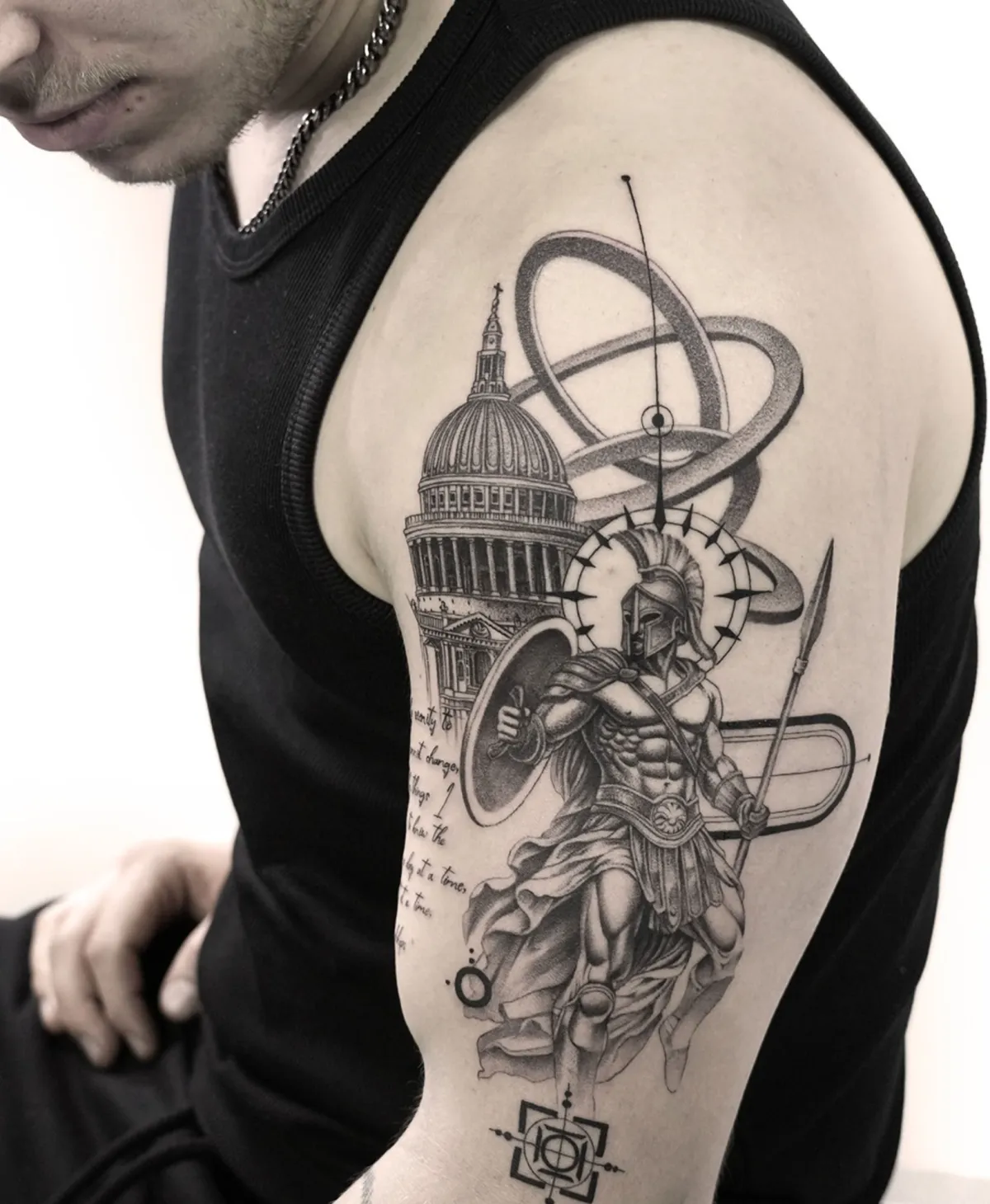
Then a client came to me in Helsinki with a concept for a full sleeve. That alone wasn't unusual. What was unusual was what she wanted: the same delicate, fineline quality I was known for in my smaller pieces, but stretched across her entire arm. She'd seen artists do large-scale fineline work and she wanted that level of subtlety at that scale.
My first instinct was hesitation. Fineline at that size presents real challenges. The detail needs to hold up across a much larger canvas, the composition has to flow around the arm in three dimensions, and you have to maintain that whisper-like quality without the piece looking empty or lost on the skin.
But she believed I could do it, and her confidence pushed me to figure it out. I spent weeks on the design, rethinking how I approached composition. I learned to use negative space more intentionally, to let breathing room become part of the design rather than fearing it. That sleeve ended up being a pivotal piece for me. It expanded what I thought was possible in my own style.
Some of the best growth doesn't come from within. It comes from someone else seeing potential in you that you haven't claimed yet.
When a Reference Image Opens a Door
I had a client come in during a guest spot in Berlin with a reference that stopped me in my tracks. It wasn't a tattoo reference -- it was a photograph from an old Japanese botanical encyclopedia, something from the early 1900s. The illustrations had this quality I'd never seen: scientifically precise but somehow emotional. Every petal was rendered with obsessive accuracy, but the overall composition felt melancholic, like the artist knew these flowers would eventually wilt.
The client wanted a piece inspired by that energy. Not a copy, but that same tension between precision and impermanence. We talked for a long time about what drew him to those images, and through that conversation, I started thinking about how to bring that quality into tattooing.
That piece pushed me into a space between realism and illustration that I hadn't explored before. I started paying attention to botanical art from different periods and cultures. I began incorporating that careful, almost scientific rendering into my design work, but always with an emotional undercurrent. It became a thread that runs through a lot of my work now.
I never would have found that thread without that client and his obscure reference book. He didn't just give me a cool image to work from -- he gave me a new artistic influence.
The Cover-Up That Taught Me Humility
Cover-ups are a specific kind of challenge. You're not starting from a blank canvas. You're working with -- and around -- something that already exists. The old tattoo dictates certain constraints: its darkness, its placement, its shape. Your job is to transform it without the viewer ever knowing something else was there first.
A client came to me with a cover-up that I initially thought was straightforward. She had a small black tattoo on her ribs -- solid, dark, not too large. She wanted it turned into something botanical. Simple enough, I thought.
But when I started designing, I realized the placement and the density of the old ink were going to fight me. Every approach I tried either didn't hide the old piece well enough or felt forced and overworked. I went through more drafts on that piece than almost anything I'd done before.
What finally cracked it was a conversation with the client where she said something offhand: "I don't mind if you can still kind of see it underneath. It's part of my history." That reframed everything. Instead of trying to completely obliterate the old tattoo, I designed something that incorporated its shadow. The dark areas of the old piece became the deep shadows in a peony. The shape of the old design informed the curve of the stems.
That piece taught me that cover-ups aren't always about erasure. Sometimes they're about integration. The client's willingness to accept imperfection -- to let the past show through -- gave me permission to approach the work differently. I carry that lesson into every cover-up I do now.
Style Combinations I Never Would Have Tried
One of the most exciting things about tattooing in multiple cities is the range of aesthetic sensibilities I encounter. Helsinki, Amsterdam, and Berlin each have distinct visual cultures, and the clients who find me in each city often want different things.
A client in Amsterdam once asked me to combine geometric patterns with organic, flowing botanical elements in a single composition. At the time, those felt like opposing languages to me -- geometry is rigid, structured, mathematical; botanicals are organic, irregular, alive. I wasn't sure they could coexist without one undermining the other.
But the client was insistent, and she had a clear vision. She showed me examples from architecture where geometric frameworks held organic forms -- Art Nouveau ironwork, Islamic tile patterns with floral motifs. She wasn't asking me to smash two styles together. She was showing me the long history of those styles being in conversation.
That piece became one of the most interesting compositions I've ever designed. The geometric elements provided structure, and the botanicals softened and disrupted that structure in ways that created tension and beauty. It's a combination I've returned to multiple times since, always because that first client showed me it was possible.
The Lesson That Keeps Repeating
If I'm being honest with myself, there's a pattern here. Every significant leap in my work has involved a moment where a client's idea initially made me uncomfortable. Not because the idea was bad, but because it asked me to do something I wasn't sure I could do. That discomfort is a signal. It means I'm at the edge of what I know, and the client is inviting me to step past it.
I think some artists resist that. They want to stay in their lane, do what they're known for, and maintain total control over the creative process. I understand that impulse. But I've learned that the artists I admire most -- in tattooing and in every other medium -- are the ones who remain students. Who stay curious. Who let the work surprise them.
The moment you think you've mastered your craft is the moment you stop growing. My clients keep me honest about that.
What This Means for You
If you're thinking about getting a tattoo with me, I want you to know that your ideas matter. Not just as a starting point that I'll "fix" with my expertise, but as a genuine creative contribution. You see the world differently than I do. You've been exposed to art, images, textures, and experiences that I haven't. When you bring those references and ideas to our consultation, you're not just telling me what you want -- you're teaching me something.
So don't hold back. Bring me the weird reference. Bring me the combination that doesn't seem like it should work. Bring me the challenge. Show me the photograph from your grandmother's attic, the textile pattern from your travels, the album cover that changed your life.
I can't promise I'll use every reference exactly as you imagined. But I can promise that I'll take it seriously, that I'll let it influence the work, and that the final piece will be richer because you brought your full self to the process.
The best tattoos I've ever done didn't come from me alone. They came from the space between my skill and someone else's vision. That space is where the real art happens.