
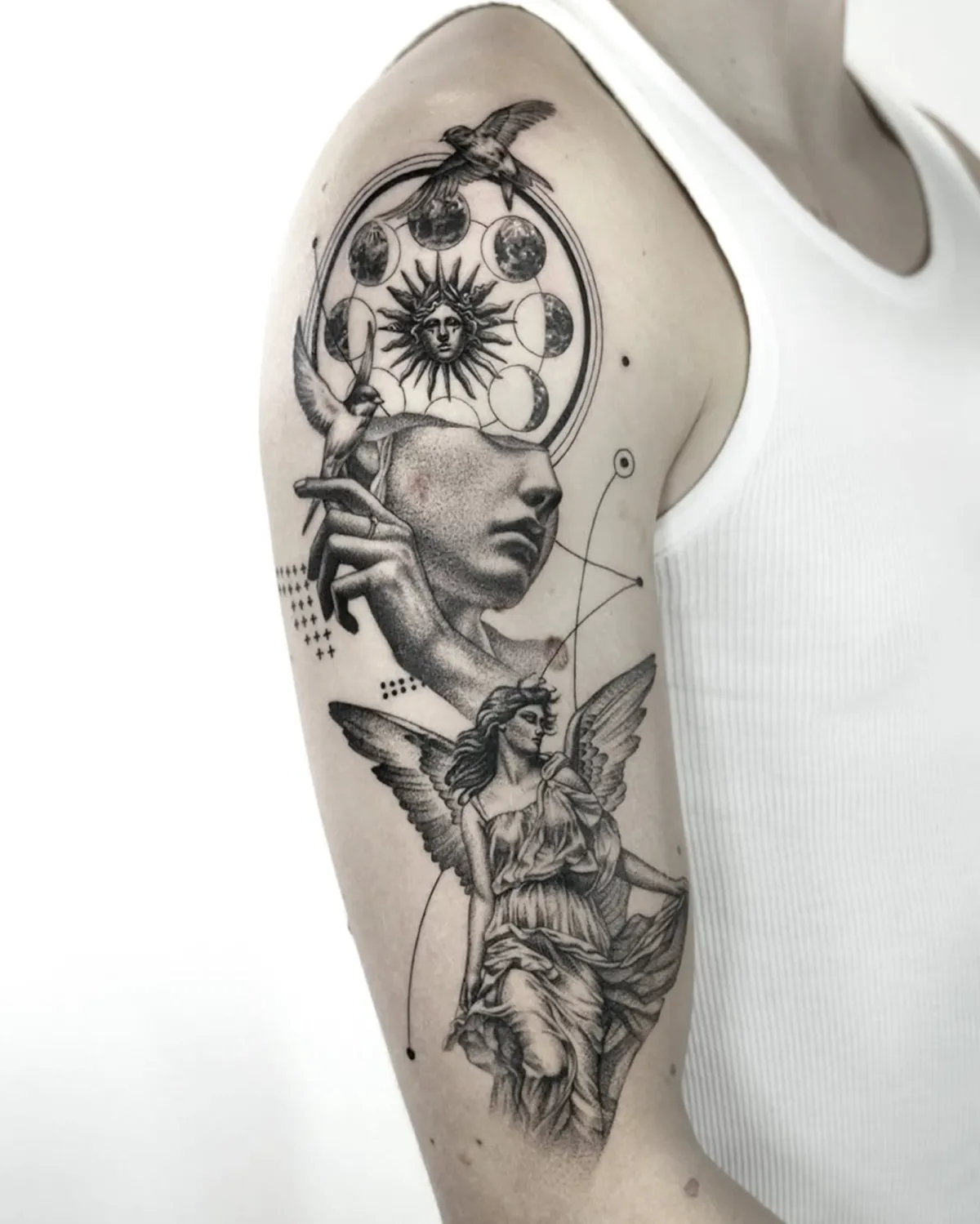
Looking Outside to See Better
There's a trap that's easy to fall into as a tattoo artist: you only look at other tattoos for inspiration. You scroll through tattoo-focused Instagram accounts, you study other tattooers' portfolios, you attend tattoo conventions. And all of that is valuable. But if that's the only well you're drawing from, your work starts to become a copy of a copy of a copy, each generation a little more diluted than the last.
The most important creative decision I've made is to deliberately seek inspiration from outside the tattoo world. Photography, painting, sculpture, architecture, film, graphic design -- these disciplines have taught me more about tattooing than any tattoo tutorial ever could. Not because they're directly applicable, but because they force me to think about fundamental artistic principles that transcend any single medium.
I'm lucky to live and work in three cities -- Helsinki, Amsterdam, and Berlin -- that are rich with museums, galleries, and creative culture. I take advantage of that constantly. Here's what the other art forms have taught me.
Photography: The Art of Seeing
If I had to choose one art form that has most influenced my tattooing, it would be photography. Not because I'm a skilled photographer -- I'm decidedly not -- but because studying photography taught me how to see.
Composition is the big one. Photographers think obsessively about how elements are arranged within the frame. The rule of thirds, leading lines, negative space, the relationship between foreground and background. These principles apply directly to tattoo design, but I didn't fully internalize them until I started studying photography seriously.
Before, I'd design a tattoo by focusing on the subject -- the rose, the skull, the portrait -- and treating the surrounding space as an afterthought. Photography taught me that the space around the subject is just as important as the subject itself. Negative space in a tattoo gives the eye room to rest, creates visual rhythm, and allows the main elements to breathe. A tattoo that fills every available inch of skin might demonstrate technical skill, but it often lacks the visual clarity of a piece with thoughtful composition.
Contrast is the other great lesson from photography. Black and white photography in particular -- which connects directly to my black and grey tattoo work -- is entirely about the relationship between light and dark. I've spent hours studying the work of photographers like Sebastiao Salgado and Josef Koudelka, whose black and white images have a tonal richness that's almost painterly. They understand that true black and pure white are powerful anchors, and that the magic happens in the vast range of greys between them.
This directly changed how I approach value structure in my tattoos. I push my darks darker and protect my lights more aggressively. I pay attention to the full tonal spectrum rather than clustering everything in the middle values. The result is work with more depth, more drama, and more visual impact.
Negative space in a tattoo gives the eye room to rest, creates visual rhythm, and allows the main elements to breathe.
Painting: Texture, Mark-Making, and Emotion
Painting teaches things that photography can't, because painting is fundamentally about the mark. Every brushstroke is a decision -- its width, its pressure, its direction, its speed. And every mark carries emotional weight.
I think about this constantly when I'm tattooing. The way I move the needle is my version of a brushstroke. A smooth, flowing line conveys something different from a textured, stippled one. The "marks" I make on skin carry the same kind of expressive potential as marks on canvas, and studying painters has helped me become more intentional about that.
The Impressionists taught me about the power of visible mark-making. Rather than blending everything into smooth perfection, they let individual brushstrokes remain visible, and those strokes create an energy and vibrancy that hyper-smooth rendering can't match. I've translated this into some of my tattoo work, particularly in background elements and organic textures where a slightly more textured approach -- visible stippling, intentional variation in needle work -- gives the piece life.
I had a profound experience standing in front of a Rembrandt self-portrait at the Rijksmuseum in Amsterdam. Up close, the painting is almost abstract -- rough, thick strokes of paint layered and scraped. But step back three meters and it resolves into this astonishingly lifelike face. Rembrandt understood that the viewer's eye does half the work. You don't need to render every pore. You need to put the right marks in the right places and trust the eye to fill in the rest.
This principle is crucial in tattoo realism. Especially in smaller pieces, you physically cannot include every detail. The needle has limits, the skin has limits, and the scale has limits. But if you place your values and marks strategically, the viewer's brain completes the image. Learning when to render and when to suggest is one of the hardest lessons in realism, and painting taught it to me better than any tattoo workshop could.
Sculpture: Understanding the Body as Form
Tattooing is not a flat medium. We work on the human body -- a complex, three-dimensional form with curves, hollows, joints, and muscles. Every surface we tattoo has its own geometry, and ignoring that geometry leads to designs that look great on paper but awkward on skin.
Studying sculpture helped me understand this in a visceral way. Sculptors don't think in flat planes. They think about how form turns, how light falls across a curved surface, how the viewer's eye travels around a three-dimensional object. When I started thinking about my tattoo designs in those terms -- not as flat images applied to skin, but as designs that wrap around and respond to the body's form -- my work improved dramatically.
A tattoo on a forearm, for example, isn't just a rectangle of skin. The forearm is a cylinder that tapers, with muscle groups that shift when the arm moves. A design that follows the natural flow of the anatomy -- that wraps with the muscle rather than against it -- looks integrated and intentional. A design that ignores the anatomy looks pasted on.
I visit the sculpture collections at museums whenever I can. The Kiasma in Helsinki has contemporary pieces that challenge how I think about form and space. The classical collections in Berlin's Altes Museum offer lessons in how the human form has been idealized and represented across centuries. Even just walking through these spaces, letting my eyes follow the curves of carved marble, trains my sense of three-dimensional awareness.
Architecture: Structure, Pattern, and Geometry
This one might seem unexpected, but architecture has become a major source of inspiration for my geometric and design-oriented tattoo work.
Helsinki has extraordinary architecture. The clean lines of Alvar Aalto's functionalism, the ornate detail of Art Nouveau buildings in Katajanokka, the raw concrete of Brutalist structures from the 1960s. I walk through the city with my eyes constantly scanning facades, doorways, floor patterns, ceiling vaults. The geometric relationships in architecture -- the way repetition creates rhythm, the way symmetry creates stability, the way a single broken element creates visual interest against a regular pattern -- all of this feeds directly into my tattoo designs.
Berlin's architecture is another wellspring. The contrast between the ornate Wilhelmine buildings and the stark modernism of Bauhaus-influenced structures creates a visual vocabulary of opposition that I find endlessly stimulating. And Amsterdam's canal houses, with their narrow facades and decorative gable stones, have a vertical elegance that has influenced how I think about tall, narrow tattoo compositions on limbs.
When I design geometric tattoo pieces -- mandalas, patterns, sacred geometry -- I'm drawing on architectural principles whether I realize it or not. The importance of a strong underlying grid. The power of symmetry. The way small variations within a regular pattern create richness without chaos. Architecture teaches these lessons at a massive scale, and I translate them to the intimate scale of skin.
Film and Graphic Design: Narrative and Clarity
I want to briefly mention two other art forms that have shaped my thinking. Film taught me about narrative -- how to guide the viewer's eye through a sequence, how to create mood through contrast and pacing, how a single powerful image can tell an entire story. When I design larger tattoo pieces that need to convey a narrative or an emotional arc, I think in cinematic terms. What's the establishing shot? Where's the focal point? How does the eye move through the composition?
Graphic design taught me about clarity and hierarchy. A great poster communicates its message instantly, even from across a room. The primary element dominates, secondary elements support, and nothing competes for attention. I apply this same hierarchy to tattoo design. What should the viewer see first? What supports that primary reading? What can be simplified or eliminated to strengthen the overall impact?
Feeding the Work
The practical manifestation of all this is simple: I spend time with art. I visit the Ateneum and Kiasma in Helsinki regularly. When I'm in Amsterdam, I make time for the Rijksmuseum, the Stedelijk, and smaller galleries in the Jordaan. In Berlin, the entire Museum Island is a pilgrimage, and the street art scene in Kreuzberg and Friedrichshain offers a different but equally valuable education.
I also read voraciously -- art history, photography monographs, design theory. I keep a folder on my phone of images from non-tattoo sources that inspire me. A shadow on a building, a texture in a painting, a composition in a film still. These fragments accumulate over time and become a visual library that I draw from, often unconsciously, when I'm designing.
The most original work comes not from studying your own craft in isolation, but from connecting it to the vast world of art and ideas that surrounds it.
None of this makes me less of a tattoo artist. If anything, it makes me more of one. Tattooing is not separate from the broader world of art and design. It exists within it, draws from it, and contributes to it. The more I engage with that broader world, the richer my tattoo work becomes. The references are deeper, the compositions are stronger, the technical choices are more informed.
I'd encourage any tattoo artist reading this to step away from the tattoo feeds for an afternoon and go to a museum. Sit with a painting for twenty minutes. Really look at it. Ask yourself what the artist is doing and why it works. Then take that understanding back to your desk, back to your machine, and see what happens.
You might be surprised by what you find.