
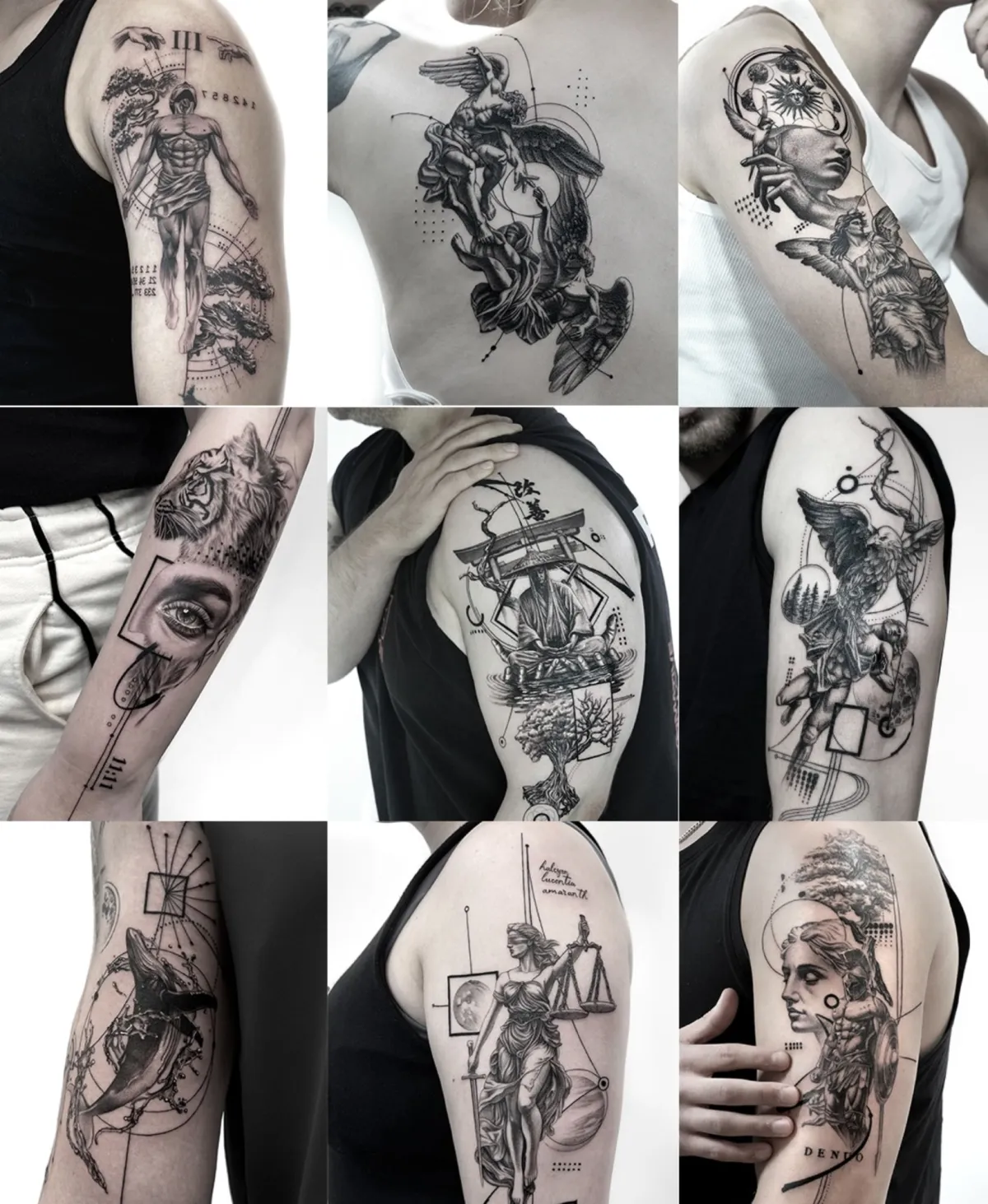
The Craft Is Always Moving
There's a misconception that tattooing is a static craft -- that once you've learned the fundamentals, you just repeat them for the rest of your career. I bought into that idea myself for a brief, naive period early on. Then I watched the industry evolve at a pace that made it clear: if you're not learning, you're falling behind.
The tools change. The techniques change. Client expectations change. The artists pushing the boundaries of what's possible on skin are doing things today that would have seemed impossible ten years ago. And to keep up -- to contribute something meaningful to this craft -- I have to keep evolving too.
This post is about the specific ways I've done that. Not abstract philosophy about growth, but the actual techniques, tools, and experiences that have shaped how I work.
Needles: The Foundation You Never Stop Exploring
Let's start with something that might sound basic but is endlessly deep: needle configurations. When I first started tattooing, I used a pretty standard setup. Round liners for outlines, magnum shaders for fill. That's what I was taught, and for a while, it was all I knew.
But the world of tattoo needles is vast, and the differences between configurations are subtle in a way that only becomes apparent through hundreds of hours of use. I've spent years experimenting, and I'm still discovering new approaches.
The biggest shift for me came when I started working with single needle and tight round liner setups for my fineline work. A true single needle -- one point, no grouping -- produces a line of extraordinary delicacy. But it's also incredibly demanding. The margin for error is essentially zero. You need absolute control over your hand speed, machine voltage, and needle depth. Too fast and you skip. Too slow and you blow out the line. Too deep and it migrates. Too shallow and it falls out during healing.
I spent months just practicing single needle lines on practice skin before I felt confident enough to use it on a client. Even now, I approach every single needle session with a level of focus that's almost exhausting. But the results are worth it -- there's a refinement to true single needle work that you simply can't achieve with a three-round liner.
More recently, I've been exploring curved magnum configurations for my black and grey realism work. Traditional flat magnums lay ink in a more uniform pattern, which is great for solid fill. But curved magnums conform to the skin's surface differently, allowing for softer gradients and more organic shading. The learning curve was steep -- the way a curved mag moves through skin is fundamentally different from a flat, and I had to retrain my hand pressure and angle. But it's opened up possibilities in my realism work that I'm genuinely excited about.
The world of tattoo needles is vast, and the differences between configurations are subtle in a way that only becomes apparent through hundreds of hours of use.
Going Digital Without Losing the Handmade
I resisted digital design tools for longer than I should have. I was stubborn about it. I believed that if a design wasn't drawn by hand on paper, it somehow lacked authenticity. Looking back, that was pride talking, not reason.
The turning point was watching a guest artist at a studio in Amsterdam design a full sleeve on an iPad Pro using Procreate. She worked with a speed and flexibility that was staggering. Resize this element, mirror that symmetry, test three different compositions in the time it would take me to sketch one. And the final result? Beautiful. Clearly the work of a skilled hand, just using a different medium.
I bought an iPad the next week.
Learning Procreate was its own journey. The app is powerful, but using it well for tattoo design requires understanding things like how to set up canvases at the right resolution, how to use layers effectively for complex compositions, and how to simulate the look of your actual tattoo work in the design phase. I spent weeks just figuring out which brushes gave me line quality closest to what my machines produce on skin.
Now, I use a hybrid approach. Most of my designs start as rough pencil sketches on paper -- that initial creative phase still feels most natural with a physical tool in my hand. Then I photograph the sketch, import it into Procreate, and refine it digitally. I can experiment with placement by overlaying the design on photos of the client's body. I can adjust proportions, test different levels of detail, and iterate quickly based on client feedback.
The paper purist in me has made peace with this. The tool doesn't define the art. My hand and my eye define it, regardless of whether I'm holding a pencil or a stylus.
Conventions, Workshops, and the Value of Being in the Room
Tattoo conventions get a mixed reputation. Some people see them as spectacle -- loud, chaotic, more about showmanship than substance. And sure, there's an element of that. But for me, conventions have been some of the most valuable learning experiences of my career.
Not because of the competitions or the crowds, but because of what happens in the quieter moments. Watching another artist work live, up close, for hours. Seeing their hand position, their machine angle, the way they wipe, the way they stretch skin. These tiny details that you'd never pick up from an Instagram video or a YouTube tutorial. There's no substitute for being in the room.
I try to attend at least two or three conventions a year across Europe. Each one exposes me to artists working in styles and traditions I might never encounter otherwise. At a convention in Berlin, I watched a Japanese-style artist use a hand-poke technique with a precision that redefined my understanding of what's possible without a machine. At another in London, I sat through a workshop on color theory specifically for tattoo application -- how different skin tones absorb pigment differently, how colors shift over time, how to choose palettes that age gracefully. That workshop alone changed how I approach every color piece I do.
Learning from Studio Culture in Amsterdam and Berlin
Guest-working has been one of the most important decisions I've made for my growth. Helsinki has a strong tattoo scene, but it's relatively small. By regularly working in Amsterdam and Berlin, I expose myself to entirely different studio cultures and artistic approaches.
Amsterdam studios tend to have a very international, experimental energy. The city attracts artists from everywhere, and the cross-pollination of styles and ideas is constant. I've picked up techniques there that I never would have encountered in Finland -- specific approaches to geometric dotwork, methods for achieving certain textures in neo-traditional work, even practical things like aftercare protocols that differ from what I learned at home.
Berlin is different again. The tattoo culture there has a raw, boundary-pushing quality. Artists in Berlin seem less concerned with commercial appeal and more focused on artistic expression. Working in that environment pushes me to take risks in my own work, to try things that might not be "safe" but that stretch my abilities.
Every time I guest-work, I come home to Helsinki with new ideas, new techniques, and a renewed sense of what's possible. It's like resetting my creative compass.
Staying Current Without Chasing Trends
The tattoo industry moves fast, especially on social media. New "trends" emerge every few months -- micro-realism, watercolor, ignorant style, AI-assisted designs. There's pressure to jump on every new thing, to stay relevant by constantly adapting to whatever's getting the most likes.
I've learned to be selective about this. Not every trend represents genuine progress in the craft. Some are aesthetic fads that will age poorly, both on skin and in the broader culture. The skill is in distinguishing between genuine innovations worth learning and superficial trends worth ignoring.
For example, the recent advances in cartridge needle systems and wireless machines represent real, meaningful improvements in the tools of the craft. They offer better precision, less trauma to the skin, and more ergonomic working conditions. I invested time in learning these systems because the benefits are tangible and lasting.
On the other hand, I've deliberately avoided certain trendy styles that I believe compromise the long-term quality of the tattoo. Ultra-fine single-pass lines that look incredible fresh but fade to near-invisibility within a few years. Watercolor techniques that abandon outlining entirely, leading to designs that blur and lose definition over time. I want my work to look good not just on Instagram the day it's done, but on the client's skin twenty years from now.
I want my work to look good not just on Instagram the day it's done, but on the client's skin twenty years from now.
The Mindset Behind Continuous Learning
At the core of all of this -- the needle experiments, the digital tools, the conventions, the guest work -- is a mindset. It's the belief that I am not a finished product. That my skills today are just a snapshot, a point on a longer trajectory.
This isn't always comfortable. Learning means confronting what you don't know. It means sitting in a workshop surrounded by artists who are better than you at something and accepting that gap. It means trying a new technique and failing at it, publicly, in a studio full of peers.
But that discomfort is the price of growth. And I'd rather pay it than settle into the quiet decline of thinking I already know enough.
I'm currently working on improving my cover-up techniques. Cover-ups are some of the most challenging work in tattooing -- you're not just creating something new, you're engineering a design that conceals something existing while still looking intentional and beautiful. It requires understanding how ink interacts with ink already in the skin, how to use density and value strategically, how to design around limitations. I'm nowhere near where I want to be with it. But I'm closer than I was last month, and next month I'll be closer still.
That's the process. That's always been the process. And I trust it completely.