
Where It Started
When I first fell in love with tattooing, it was fineline work that captivated me. There was something about the elegance of it -- a single, impossibly thin line creating something delicate and precise on skin. It felt like the purest expression of control. A fine line tattoo doesn't shout. It whispers. And I was drawn to that subtlety.
My earliest work was almost entirely fineline. Small botanical pieces, minimalist geometric designs, script with hairline strokes. I loved the challenge of it: the absolute steadiness of hand required, the way even the slightest tremor would show, the need for perfect consistency across the entire piece. Fine line work taught me discipline. It taught me that in tattooing, less can absolutely be more.
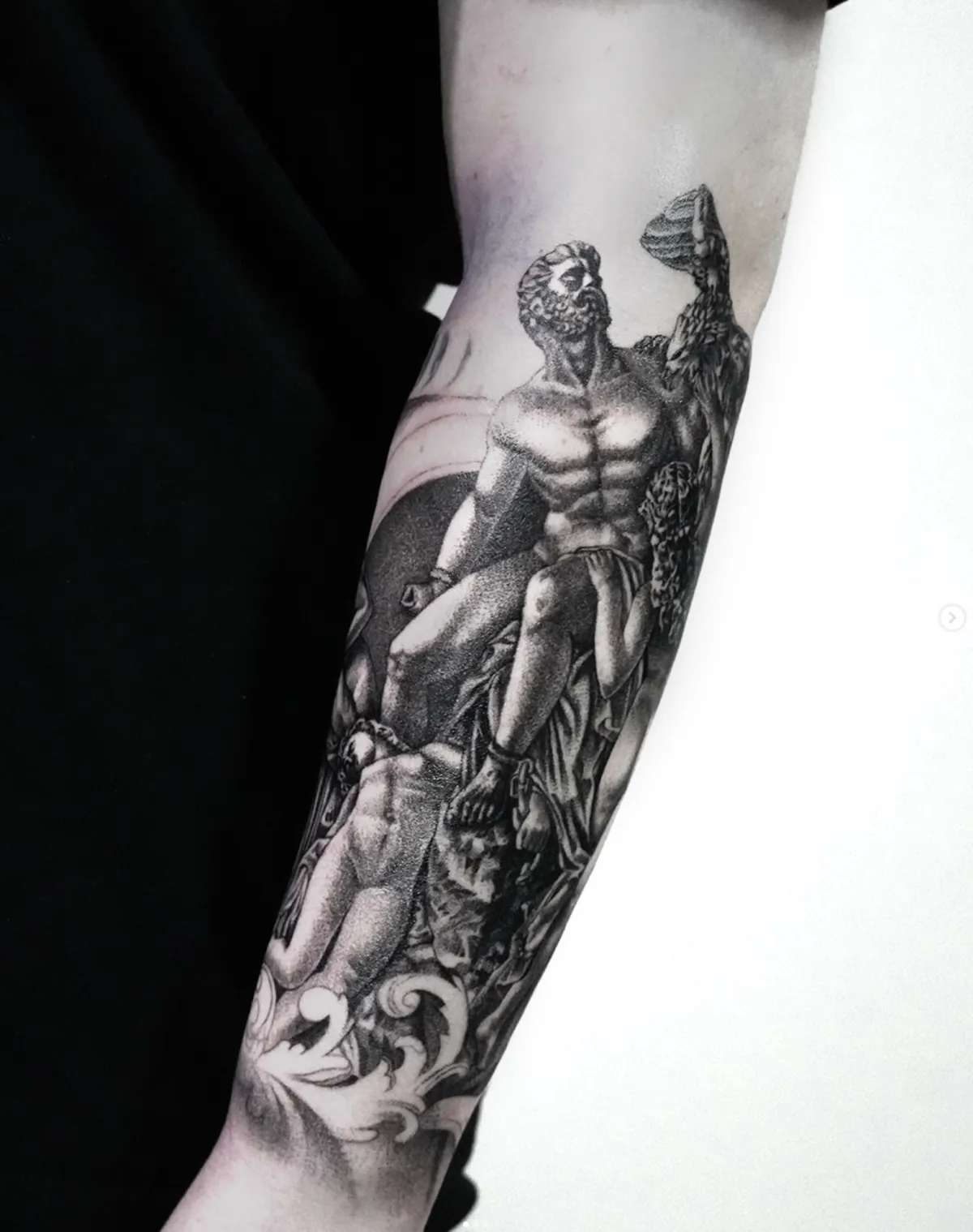
But over time, I started to feel the pull toward something different. I'd see black and grey realism pieces -- portraits, animals, nature scenes rendered with photographic depth and dimension -- and feel a mix of admiration and frustration. Admiration because the skill level was extraordinary. Frustration because I knew I couldn't do it. Not yet.
The Decision to Expand
Making the decision to seriously pursue realism was harder than it sounds. I had built my reputation on fineline work. Clients came to me specifically for that style. Pivoting -- even partially -- felt risky. What if I wasn't good at it? What if I spread myself too thin and my fineline work suffered?
But I kept coming back to a simple truth: I wanted to grow. Not just as a tattoo artist, but as an artist, period. Staying in one lane forever, no matter how comfortable, felt like a form of creative stagnation. I didn't want to be known as the guy who does one thing well. I wanted to be known as someone who can do many things with integrity and skill.
So I started learning. And I quickly discovered that realism was an entirely different animal from fineline work. The skills don't just transfer automatically. You have to build new ones almost from scratch.
The Technical Leap
The biggest difference between fineline and realism is shading. Fine line work is fundamentally about line -- its weight, its consistency, its placement. Realism is fundamentally about tone. It's about building up layers of value to create the illusion of three-dimensional form on a flat, living surface.
When I started practicing realism, my shading was rough. I'd been so focused on clean lines for so long that my approach to filling areas with gradual tone was mechanical and stiff. I could see the "steps" in my gradients. The transitions between light and shadow looked banded rather than smooth. It was humbling.
I went back to basics. I spent weeks doing nothing but pencil shading exercises on paper -- spheres, cylinders, draped fabric, crumpled paper. I studied how light wraps around forms, where the core shadow falls, how reflected light bounces off surfaces and softens the shadow edge. This is fundamental art school stuff, and I needed all of it.
On skin, the challenges multiply. Skin has texture, elasticity, and color of its own. Ink doesn't just sit on the surface -- it settles into layers of the dermis, and different areas of the body hold ink differently. The smooth gradient I could achieve on paper required a completely different technique on a forearm versus a ribcage.
I experimented endlessly with needle configurations, machine speed, and hand pressure. I learned that realism shading often requires multiple passes at different depths. A first pass to establish the base tone, then building up darker values gradually, letting the skin rest between sessions if needed. Patience became even more critical than it was with fineline work.
Realism is fundamentally about tone. It's about building up layers of value to create the illusion of three-dimensional form on a flat, living surface.
Black and Grey: A World of Subtlety
I chose to focus specifically on black and grey realism rather than color realism, partly because it connects naturally to my fineline roots -- both rely on a monochromatic palette -- and partly because I find black and grey endlessly rich in its subtlety.
Working in black and grey means you have one ink and one spectrum of dilution to create every value from deepest black to lightest grey. The entire illusion of form, depth, texture, and light comes from how you manage that single variable. There's no color to distract the eye or compensate for weak structure. If your values are off, the whole piece falls apart.
I became obsessed with understanding value structure. I'd take reference photos and convert them to grayscale, studying where the darkest darks and lightest lights fell. I'd squint at images until the details dissolved and only the broad value masses remained. This practice of seeing in values rather than details is, I think, the most important skill in black and grey realism.
One technique that transformed my work was learning to preserve the skin tone itself as a value. In black and grey realism, the lightest value in your piece isn't white ink -- it's the client's natural skin. Learning to leave strategic areas untouched, using the bare skin as your highlight, gives the work a luminosity that you can't achieve any other way. It sounds simple, but it requires careful planning and the confidence to leave space rather than filling everything.
What Fineline Taught Me About Realism
Here's what surprised me: my fineline background actually gave me significant advantages in realism that I didn't expect.
Fine line work trains your hand for precision -- and realism, it turns out, is built on precision too. It's just a different kind. Instead of precise lines, you need precise control over needle depth, hand speed, and ink saturation on every single pass. The steady hand I developed pulling clean fine lines translated directly to the controlled, deliberate strokes needed for smooth shading.
Fineline work also taught me about composition in small spaces. Many of my fineline pieces are compact -- wrist tattoos, ankle pieces, small designs behind the ear. Working in small scales forces you to simplify, to distill a design to its essential elements. This skill became invaluable when I started doing smaller realism pieces, where you don't have the luxury of a full back panel to render every detail. Knowing what to include and what to leave out is just as important in realism as it is in fineline.
And the patience -- the absolute, unreasonable patience that fineline work demands -- transferred completely. Realism is a slow process. A detailed black and grey portrait might take six to eight hours or more. You can't rush it. You have to trust the process, build up values gradually, and resist the temptation to push too hard too fast. Fineline work had already taught me that lesson through thousands of hours of practice.
What Realism Taught Me About Fineline
The reverse was equally true. Learning realism made my fineline work better in ways I didn't anticipate.
Understanding three-dimensional form more deeply allowed me to add subtle dimension to my fineline pieces. A botanical illustration that would have been purely flat linework before could now have a gentle suggestion of shadow -- just a whisper of tonal variation that makes the leaf curl off the skin or the petal fold with weight. It's still fineline in spirit, but with a new depth that it lacked before.
Realism also sharpened my understanding of contrast. In fineline work, I used to treat all lines as roughly equal in weight. After studying realism, I understood that varying line weight according to light and shadow -- thickening lines in shadow areas, thinning them in highlights -- creates a more dynamic and visually compelling result. This principle comes directly from how light defines form, which is the entire foundation of realism.
Cover-Ups: Where Everything Converges
Cover-up work is where all my skills converge, and it's become one of my most requested services. A good cover-up requires fineline precision for the detailed elements, realism-level shading to create depth and density that conceals the old tattoo, and a design sensibility that incorporates the existing marks rather than just bulldozing over them.
Every cover-up is a puzzle. You're working with constraints that don't exist in a fresh tattoo -- the shape, density, and color of the old ink dictate what's possible. I have to analyze the existing tattoo, understand how the old ink will interact with new ink over time, and design something that turns a source of frustration into a source of pride.
This is where versatility truly matters. If I could only do fineline, I couldn't offer effective cover-ups -- you need density and tonal range to obscure old work. If I could only do realism, I'd be limited in the design approaches available. Being able to move between styles means I can choose the right approach for each specific cover-up situation.
Why Versatility Matters
Some tattoo artists are specialists, and I have deep respect for that path. An artist who dedicates their entire career to one style can achieve a level of mastery that's genuinely awe-inspiring. But that wasn't the path for me.
I serve a diverse range of clients with diverse tastes, ideas, and needs. Someone comes to me wanting a delicate fineline piece on their collarbone, and the next person wants a detailed black and grey portrait on their upper arm, and the person after that needs a creative cover-up on their forearm. Being able to serve all of them -- and serve them well -- is important to me.
Being able to move between styles means I can choose the right approach for each specific situation, rather than forcing every idea into the same mold.
More than that, the cross-pollination between styles makes me better at each one individually. Fineline informs my realism. Realism deepens my fineline work. Cover-up work tests both. Each style teaches principles that echo through the others.
What I'm Still Learning
I want to be transparent: I'm still very much on this journey. My realism work today is significantly better than it was two years ago, but when I look at the work of artists I admire most in this space, I see how far I still have to go. The subtlety of skin texture rendering, the ability to capture true likeness in a portrait, the management of large-scale compositions across complex body areas -- these are skills I'm actively developing.
I'm also exploring the edges where fineline and realism merge. There's a style emerging that combines the delicacy of fineline with the tonal depth of realism -- sometimes called micro-realism or fine-art tattooing. It's incredibly demanding technically, requiring the precision of single-needle work with the tonal understanding of full realism. It feels like the natural intersection of everything I've learned, and it's where I'm focusing a lot of my current growth.
The styles keep teaching me. And I keep listening.