
The Alarm Goes Off at 6:30
Most mornings, before the coffee has even finished brewing, I'm already sitting at my desk with a pencil in my hand. It's a ritual that started years ago when I was still learning to tattoo, and it's one I have no intention of breaking. People sometimes ask me, "You've been tattooing for years now -- why do you still draw every day?" The honest answer is that daily drawing is the reason I can tattoo the way I do. Without it, everything else falls apart.
I live in Helsinki, and Finnish winters are dark. There's something almost meditative about sitting in the quiet of an early morning, a single lamp on, sketchbook open, working through forms and shapes before the world wakes up. It grounds me. It reminds me that before I'm a tattoo artist, I'm an artist. And artists draw.
What I Actually Practice
My morning sessions aren't random doodling. I rotate through focused exercises depending on what I feel needs sharpening. Some weeks it's anatomy -- hands, faces, the way muscles wrap around a forearm. Hands are brutal. I've drawn thousands of them and they still humble me. But tattooing hands and fingers onto skin means I need to understand every tendon and fold, so I keep at it.
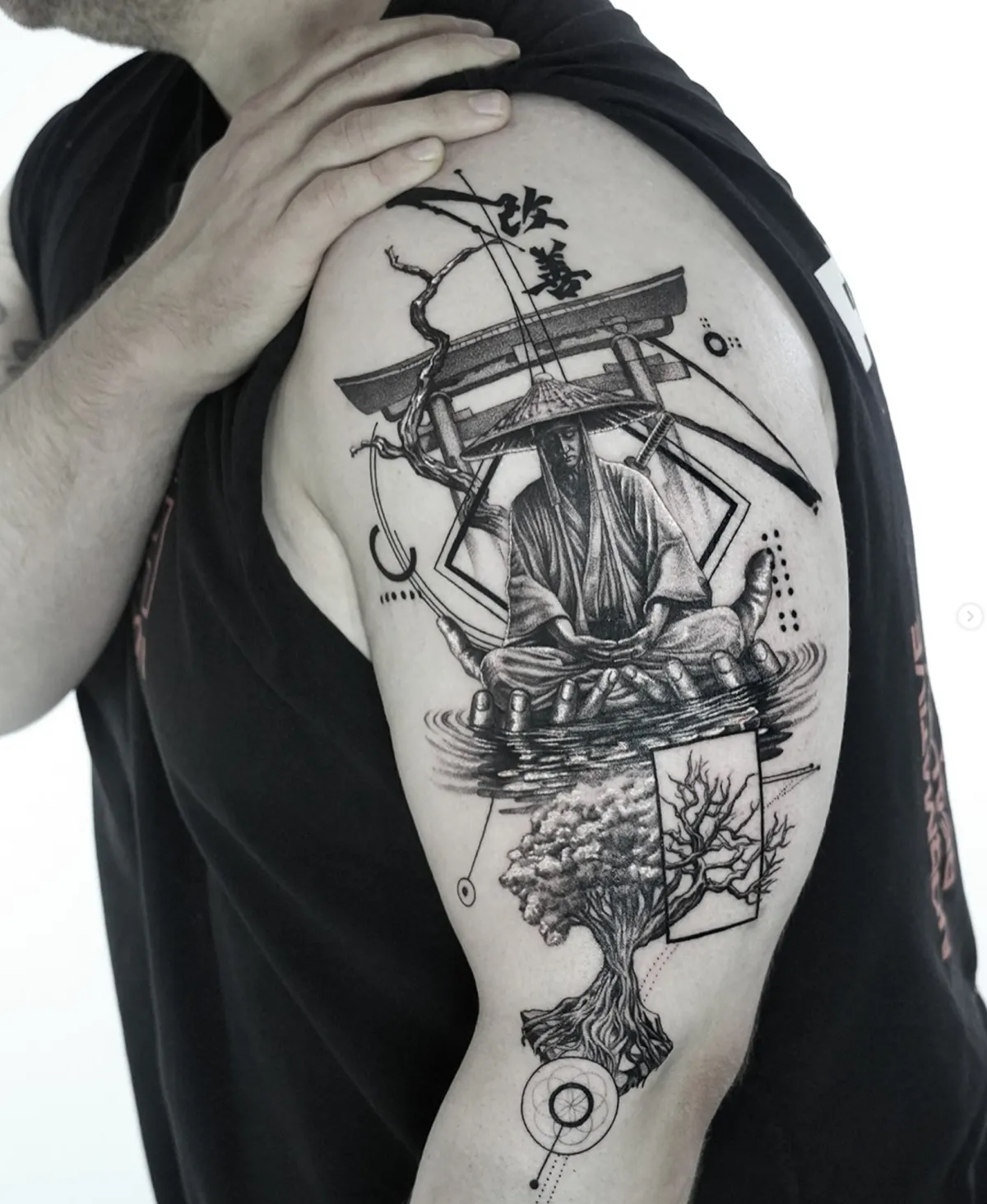
Other weeks I focus purely on shading. I'll take a simple sphere or cylinder and spend an hour building up tonal gradations with just a pencil. Smooth transitions, hard edges, reflected light. This is the stuff that directly translates to black and grey realism on skin. The pencil teaches patience. You can't rush a smooth gradient on paper, and you definitely can't rush one with a tattoo machine.
I also dedicate time to studying styles outside my comfort zone. I'll flip through books of traditional Japanese ukiyo-e prints, or study botanical illustrations from the 18th century, or break down the linework in contemporary graphic novels. I'm not trying to master every style, but I want to understand the principles behind them. There's always something to steal -- in the best possible sense -- from other traditions.
The pencil teaches patience. You can't rush a smooth gradient on paper, and you definitely can't rush one with a tattoo machine.
How It Translates to Better Tattooing
Here's the thing that's hard to explain to people outside the craft: tattooing is not just "drawing on skin." The skin is a living, breathing, imperfect canvas. It moves, it bleeds, it reacts. The needle doesn't glide like a pen. You're working with resistance, with depth, with the unpredictable texture of human tissue. Every variable is different from client to client.
But when your drawing fundamentals are rock solid, you can handle those variables. If I deeply understand how light falls across a three-dimensional form because I've drawn it five hundred times on paper, I can adapt when the skin behaves differently than I expected. I'm not thinking about the basics anymore -- they're automatic. My brain is free to focus on the challenges unique to that specific tattoo on that specific person.
I notice the difference most with fineline work. Fine lines are unforgiving. There's no hiding behind heavy shading or bold outlines. Every tremor, every moment of hesitation, shows. My daily drawing practice keeps my hand steady and my confidence high. When I pull a long, clean line on skin, it's because I pulled a thousand of them on paper that week.
The Difference Between "Good Enough" and Growth
Early in my career, I hit a point where I thought I was "good enough." My clients were happy. My bookings were full. I could have coasted. I think a lot of artists reach that plateau and decide to stay there, and I understand why -- the work is demanding, life is busy, and comfort feels earned.
But "good enough" started to bother me. I'd look at work by artists I admired and see a gap between what they could do and what I could do, and that gap wasn't about talent. It was about hours. It was about the daily accumulation of deliberate practice that separates someone who's competent from someone who's genuinely pushing the craft forward.
So I made a rule for myself: draw every single day, no exceptions. Sick days, travel days, days when I'm exhausted from a ten-hour tattoo session. Even if it's just twenty minutes of quick gesture sketches on a hotel notepad. The point isn't to produce a masterpiece every morning. The point is to show up. To keep the hand moving and the eye sharp.
Some days the drawings are terrible. That's fine. Terrible drawings are part of the process. They're data. They show me where my weaknesses are, which muscles in my hand are tired, which mental patterns I'm falling into. A bad drawing day teaches me more than a good one.
Learning from Other Artists
One of the best parts about guest-working in Amsterdam and Berlin is the exposure to other artists' practices. I've sat in studios with people who approach drawing in completely different ways than I do, and it's always eye-opening.
In Berlin, I met an artist who starts every day by drawing the same object -- a small bronze figure he keeps on his desk -- from a different angle. He's been doing it for over five years. Hundreds of drawings of the same figure. But each one reveals something new about form, about light, about his own ability to see. That kind of discipline blew my mind.
In Amsterdam, I worked alongside someone who spends her mornings doing blind contour drawings -- drawing without looking at the paper. It sounds like a gimmick, but it's actually a powerful exercise in training your eye to really observe rather than letting your brain fill in what it thinks it knows. I adopted it into my own routine and it genuinely improved my observational accuracy.
I also draw inspiration from artists who have nothing to do with tattooing. I keep coming back to the work of Albrecht Durer, whose engravings have a precision and density that feels almost superhuman. Or the charcoal studies of Kathe Kollwitz, which have an emotional weight that I aspire to bring into my realism work. Standing in front of an original Kollwitz drawing at the Ateneum here in Helsinki, you can almost feel the pressure of her hand. That's the level of craft I'm chasing.
The Discipline of Showing Up
People romanticize the creative life. They imagine inspiration striking like lightning, the artist in a frenzy of creation. And sure, those moments happen. But the truth is that most of the work is quiet and unglamorous. It's sitting at a desk when you'd rather be in bed. It's filling a sketchbook with studies that no one will ever see. It's trusting the process even when you can't feel the progress.
I've had stretches where I felt like I wasn't improving at all, where every drawing felt stiff and lifeless. Those periods are the real test. Because if you only practice when it feels good, you'll never build the kind of deep, reliable skill that carries you through a complex tattoo when the pressure is on.
The daily drawing habit also keeps me honest with myself. It's easy to get caught up in the business side of tattooing -- the social media, the bookings, the brand. The morning drawing session strips all that away. It's just me, a pencil, and the gap between what I can do and what I want to do. That gap is humbling, but it's also motivating. It's the reason I keep going.
What I'd Tell Any Artist Starting Out
If you're a tattoo artist early in your journey, or even someone just thinking about getting into the craft, here's my biggest piece of advice: draw every day. Not because someone told you to. Not because it looks good on Instagram. Draw because it's the single most effective thing you can do to improve your work.
Buy a cheap sketchbook and fill it. Then buy another one and fill that. Don't be precious about it. Don't worry about making "art." Worry about making your hands and eyes smarter. The tattoos will follow.
Draw because it's the single most effective thing you can do to improve your work. The tattoos will follow.
I've been doing this for years and I still feel like a student. Honestly, I hope I always feel that way. The day I think I've learned enough is the day my work starts to decline. So tomorrow morning, when the alarm goes off at 6:30, I'll be at my desk again. Pencil in hand. Ready to learn something new from a blank page.