
You Are Where You Work
I used to think style was something you developed internally — that you studied your influences, practiced your craft, and eventually your artistic voice emerged fully formed. And to some extent, that's true. But what I didn't understand until I started working across multiple cities is how much your environment shapes the art you make, whether you're conscious of it or not.
Since I began splitting my time between Helsinki, Amsterdam, and Berlin, my work has evolved in ways I never planned. Each city has its own visual language, its own design culture, its own energy. And every time I spend a stretch of weeks in one of these places, I can feel it seeping into my hands. The lines I draw start to shift. The compositions I reach for change. Even the way I approach a blank piece of skin feels different depending on which city I woke up in that morning.
This isn't something I force. It's something I've learned to welcome.
Helsinki: Where Less Becomes Everything
Helsinki is my home base, and its influence on my work runs the deepest. If you've spent any time in Finland, you know that the design culture here is built on restraint. Clean lines. Functional beauty. A deep respect for negative space. You see it in the architecture, the furniture, the way people dress, even the way conversations are structured — nothing wasted, everything intentional.
That sensibility is woven into my fineline work at a fundamental level. When I'm working in Helsinki, my designs tend to be more stripped back. I find myself removing elements rather than adding them, asking whether each line is truly necessary. There's a Finnish concept — not quite minimalism, more like an aversion to excess — that I carry with me even when I'm working in other cities.
My Helsinki clients reinforce this. They tend to come in with well-researched ideas and a clear sense of what they want. Consultations are straightforward and focused. There's rarely a request to make something bigger or busier. Instead, the conversation is usually about precision: "Can we make this line thinner?" or "What if we leave more skin showing here?" That constant pull toward refinement has made me a much more disciplined artist.
Helsinki taught me that the space between lines matters as much as the lines themselves.
The fineline and design tattoo work I'm known for was born in Helsinki. The city didn't just influence my style — it created the foundation for it. Every precise, delicate piece I do, no matter where I'm working, has Finland's fingerprints on it.
Amsterdam: The Permission to Be Bold
If Helsinki is restraint, Amsterdam is release. The first time I did a guest spot there, I was struck by how visually loud the city is. Not in a chaotic way — in a confident way. The street art, the fashion, the architecture that mixes centuries of history with unapologetic modernity. Amsterdam doesn't whisper. It speaks at full volume and trusts that you'll listen.
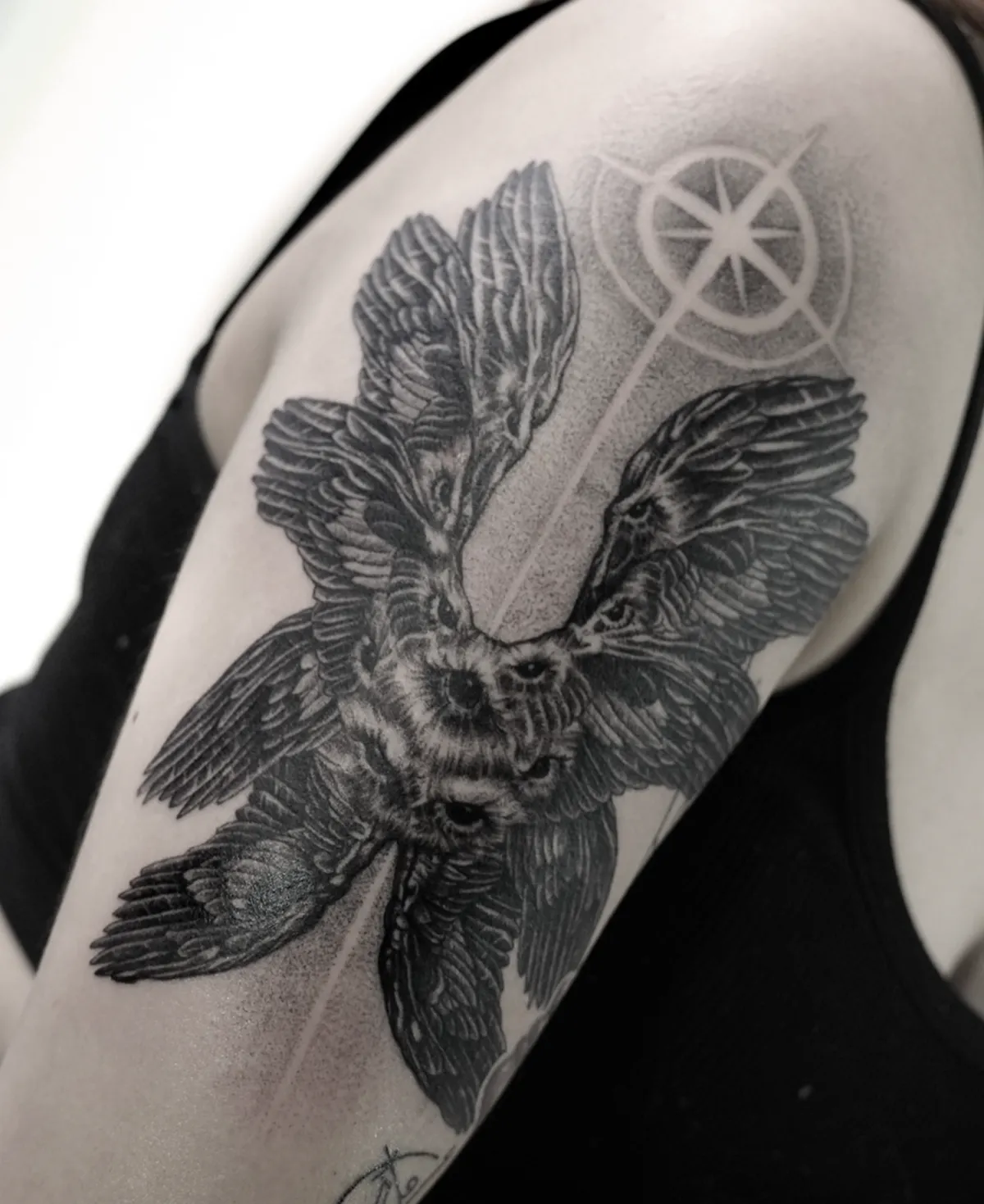
That energy shows up in my Amsterdam work almost immediately. When I'm there, my designs get bolder. I use stronger contrasts. My black and grey realism pieces take on more drama — deeper blacks, more pronounced highlights, compositions that demand attention rather than quietly inviting it. It's like the city gives me permission to push things further than I normally would.
The Amsterdam client base plays a huge role in this. The city attracts people from across Europe and beyond, and that international mix creates a client pool that's incredibly diverse in taste and expectation. In a single day, I might tattoo a delicate botanical piece for a local designer, a dramatic sleeve section for a visiting musician, and a bold geometric piece for someone who flew in from Barcelona specifically for the appointment.
That range forces me to be versatile in a way that's different from Helsinki. In Finland, my lane is more defined — clients come to me specifically for my established style. In Amsterdam, clients come to me and then push me. They bring references I wouldn't have found on my own. They suggest combinations of styles I wouldn't have considered. Some of my most innovative pieces have come from Amsterdam sessions where a client's vision challenged me to merge approaches I'd normally keep separate.
One specific influence I can trace directly to Amsterdam is my approach to composition on larger pieces. There's a tradition in Dutch art — and you feel it everywhere in the city, from the Rijksmuseum to the street murals — of dramatic, almost theatrical arrangement. Strong focal points, bold framing, a sense of narrative within a single image. I've started applying that thinking to my larger tattoo compositions, especially in my realism work, and it's given my pieces a sense of story that they didn't have before.
Berlin: The Beauty of Imperfection
And then there's Berlin. Berlin is different from anywhere else I've worked, and its influence on my art is the hardest to articulate but maybe the most important.
Berlin's creative culture is built on rawness. The city wears its history openly — the scars of the wall, the repurposed industrial spaces, the layers of street art and wheat-paste posters that cover every available surface. There's an aesthetic here that values authenticity over polish, expression over perfection. It's not that Berlin doesn't care about quality — it absolutely does. But it defines quality differently. A piece doesn't have to be flawless to be powerful. Sometimes the imperfection is what makes it powerful.
That philosophy has been genuinely transformative for my work. As someone whose foundation is in fineline and precision, I came up valuing clean execution above almost everything else. Berlin challenged that. Not by making me sloppy — I still care deeply about technical quality — but by showing me that there's beauty in looseness, in organic flow, in letting a design feel alive rather than engineered.
Berlin taught me to stop treating every tattoo like a technical exercise and start treating some of them like conversations between my hand and the skin.
My cover-up work, in particular, has been heavily influenced by Berlin. The city's ethos of transformation — of taking something damaged or outdated and making it part of something new and vital — maps perfectly onto the cover-up process. In Berlin, I started approaching cover-ups less as corrections and more as evolutions. The old tattoo isn't a mistake to be erased; it's a layer in an ongoing story. That reframing has made my cover-up consultations deeper and my results more meaningful.
Berlin clients tend to be the most adventurous of the three cities. They're less concerned with trends and more interested in something that feels uniquely theirs. They'll bring me a reference that's an architectural sketch, a film still, a page from a zine, a photograph of a crumbling building they pass every day. The references themselves are often unconventional, which pushes my designs into territory I wouldn't explore on my own.
Where the Influences Overlap
The most interesting thing about absorbing these different city influences isn't how they stay separate — it's how they blend. My current style, if I had to describe it honestly, is a conversation between all three cities happening simultaneously.
I'll design a piece that has Helsinki's precision in its linework, Amsterdam's boldness in its composition, and Berlin's rawness in its textural elements. A black and grey realism piece might have the clean technical foundation I built in Finland, the dramatic contrast I developed in Amsterdam, and the organic, slightly imperfect quality I learned to embrace in Berlin.
This blending isn't something I plan. It happens naturally as I move between cities and carry each place's influence into the next. A client in Helsinki might get a piece that subtly reflects something I saw on a wall in Kreuzberg two weeks earlier. A client in Berlin might get a design whose precision was sharpened by my Helsinki practice. The cross-pollination is constant and, I think, what makes my work feel like mine rather than like any one city's style.
The Clients in Each City
The people who sit in my chair are as much a part of this story as the cities themselves. They're the ones who bring ideas, challenge my assumptions, and ultimately determine what ends up permanently on their skin.
Helsinki clients tend to be planners. They've often been thinking about their tattoo for months or even years before they book. They come in knowing exactly where they want it, roughly how big, and with a clear aesthetic in mind. These sessions are focused and calm, and the results are usually very refined.
Amsterdam clients are collaborators. They come in with an idea but they want to build it together. The consultation is a creative conversation, and the final design often looks quite different from the initial concept. These sessions are energizing because there's a real sense of co-creation.
Berlin clients are the wild cards, and I mean that with deep affection. They're the most likely to walk in with an unusual concept, the most open to my creative interpretation, and the most willing to go somewhere unexpected. Some of my portfolio pieces that get the most attention on Instagram came from Berlin sessions where a client basically said, "I trust you — surprise me."
Travel as a Creative Practice
I've come to think of my travel between these cities not as a logistical necessity of guest work, but as a creative practice in itself. The physical act of moving between different environments keeps my work from stagnating in a way that nothing else does.
When you stay in one place, your visual diet stays consistent. You see the same streets, the same buildings, the same light. Your brain adapts to it and stops noticing. But when you land in a new city every few weeks, your eyes reset. You start seeing again — really seeing — the shapes and textures and compositions that are all around you. And that seeing feeds directly into the work.
I keep a visual journal on my phone, just photos of things that catch my eye in each city. A shadow on a Helsinki sidewalk. A color combination on an Amsterdam canal house. A texture on a Berlin factory wall. None of these are tattoo references in any obvious way, but they're all feeding the visual vocabulary that I draw from when I sit down to design.
The Artist I'm Becoming
I don't think I'd be the tattoo artist I am today if I'd stayed in one city. Helsinki made me precise. Amsterdam made me bold. Berlin made me brave. Together, they've shaped a style that I couldn't have planned or predicted — one that's constantly evolving because the influences that feed it keep changing.
If there's one thing I want other artists to take from this, it's that your environment isn't just a backdrop to your work. It's an active participant in it. Change your environment, even temporarily, and you'll change your art. Not because you're trying to, but because you can't help it. The cities you work in leave their marks on you just as surely as you leave your marks on the people who sit in your chair.
Helsinki, Amsterdam, Berlin — each one has shaped me. And I can't wait to see what the next city adds to the mix.